Beyond the Story: 5 Meaningful Questions to Ask After Reading With Your Child
There’s something special about reading a book with a child.
Maybe it’s the way they snuggle a little closer, the excitement in their voice when they recognize a favorite character, or the questions they ask when something unexpected happens.
But sometimes, the most meaningful part of storytime begins after the last page is turned.
At Believe II Be™, we believe children’s books can do more than entertain. They can open the door to conversations about feelings, friendships, choices, confidence, and the everyday experiences that shape how children see themselves and the world.
And the good news? You don’t need to be a teacher or child development expert to make those conversations meaningful.
Sometimes, all it takes is one thoughtful question.
Here are five of our favorite questions to ask after reading with your child—and why they matter.
1. “How Do You Think the Character Was Feeling?”
Why we love this question: It encourages emotional awareness and empathy.
Children experience big emotions, but they don’t always have the vocabulary to describe them.
Stories offer a gentle way to explore feelings through someone else’s experiences.
When a character becomes frustrated, disappointed, excited, or proud, children have an opportunity to notice those emotions without having to talk directly about themselves.
You might ask:
- “What do you think made the character feel that way?”
- “Can you tell by looking at their face?”
- “Have you ever felt something like that?”
Try this: Look at the illustrations together. Facial expressions, body language, colors, and other visual details can provide wonderful clues about what a character might be experiencing.
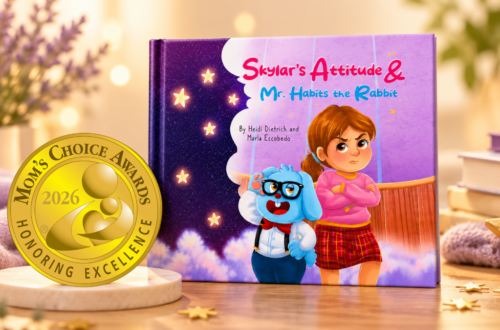
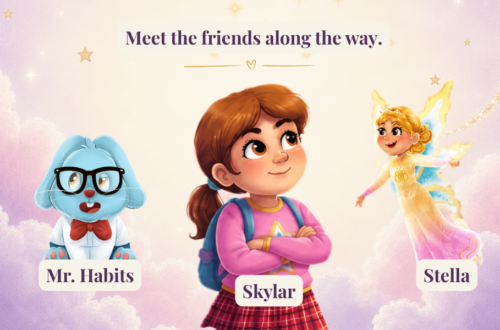
In Skylar’s Attitude & Mr. Habits the Rabbit, we included a special visual detail: Skylar’s outfit changes with her mood!
See if your child notices the changes and what they might tell us about how Skylar is feeling.
2. “What Do You Think the Character Was Thinking?”
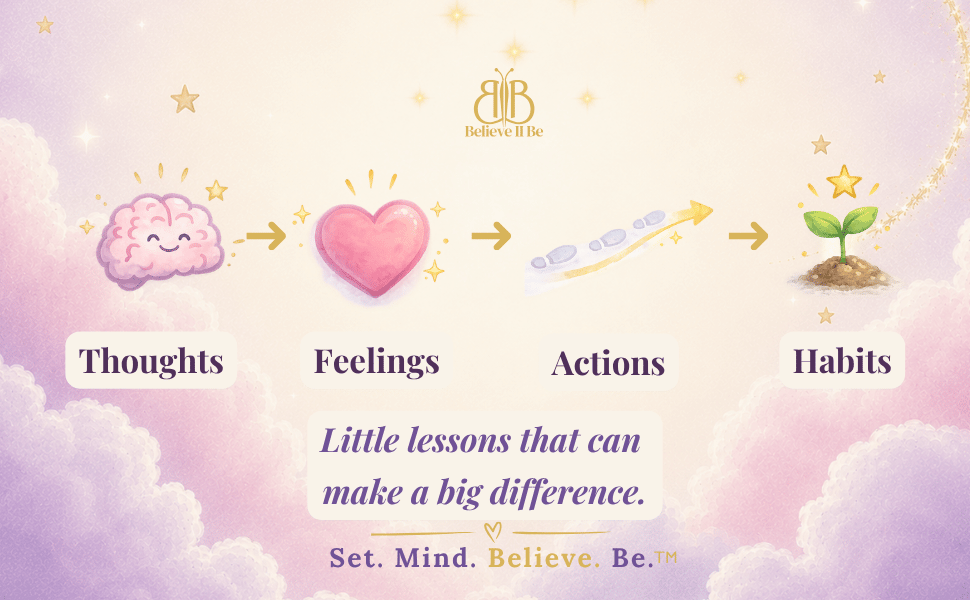
Why we love this question: It introduces the connection between thoughts and feelings.
Have you ever noticed how the same situation can feel different depending on how we think about it?
Imagine a child trying something new.
One thought might be, “I’m never going to get this right.”
Another might be, “This is hard, but I can keep practicing.”
Both thoughts can influence how the child approaches the challenge.
When we ask children what a character might be thinking, we encourage them to look beyond what happened and consider the character’s perspective.
You might ask:
- “What do you think was going through their mind?”
- “Could there be another way to think about what happened?”
- “What might a kind friend say to them?”
Try this: Invite your child to imagine a thought bubble above the character’s head. What words would they put inside it?
There are no perfect answers. The goal is to encourage curiosity and conversation.
3. “What Would You Do If You Were in Their Shoes?”
Why we love this question: It helps children explore choices and problem-solving.
One of the wonderful things about stories is that they give children a chance to imagine different situations in a safe and supportive setting.
When a character faces a challenge, children can think about what they might do in a similar moment.
Would they ask for help?
Take a deep breath?
Try again?
Talk to a friend?
This question encourages children to recognize that there may be more than one way to respond.
You might ask:
- “What would you try first?”
- “Who could help you?”
- “What might happen if you made a different choice?”
Try this: If your child suggests a response, explore it together without immediately labeling it right or wrong.
For example, you might say, “That’s interesting! What do you think might happen next?”
These conversations help children practice thinking through possibilities.
4. “What Did the Character Learn?”
Why we love this question: It encourages reflection and a growth mindset.
Children don’t need to get everything right the first time.
In fact, some of life’s most meaningful lessons come from mistakes, challenges, and unexpected experiences.
When we ask what a character learned, we’re helping children recognize that growth is a process.
A character might learn to be more patient, speak kindly, ask for help, or try something again.
And sometimes, a character’s biggest discovery is simply realizing that they have a choice in how they respond.
You might ask:
- “Did the character think differently by the end?”
- “What helped them learn something new?”
- “What advice would you give them?”
Try this: Share something you’ve learned recently, too.
Children benefit from seeing that adults are still learning, making mistakes, and growing.
You might say, “I had a frustrating moment today, but I learned that taking a break helped me think more clearly.”
Little moments of honesty can make these conversations feel more natural.
5. “What’s One Little Thing We Can Practice Together?”
Why we love this question: It helps connect stories with everyday life.
This might be our favorite question of all.
Because while reading a story can introduce a meaningful idea, practicing that idea is where children begin making it their own.
After finishing a book, invite your child to choose one small action they’d like to try.
Maybe it’s:
- Taking a slow breath when feeling frustrated.
- Using kind words when something doesn’t go their way.
- Asking for help instead of giving up.
- Trying again after making a mistake.
- Naming a feeling instead of keeping it bottled up.
The goal isn’t to create another task or expectation.
It’s simply to help children notice that the lessons in a story can become part of their everyday experiences.
Try this: Choose something to practice together.
You might say, “This week, let’s both try taking a little pause when something feels frustrating.”
When children see adults participating, the lesson becomes something shared rather than something they’re expected to do alone.
A Little Reminder: Follow Your Child’s Lead
Not every reading session needs to become a lesson.
Sometimes, children simply want to laugh at a funny illustration, point out a favorite character, or hear the same story for the tenth time.
And that’s wonderful, too.
The goal isn’t to ask all five questions every time you read.
Choose one that feels natural.
Listen to your child’s response.
Let the conversation go wherever their curiosity takes it.
Some children may have lots to say. Others may prefer to point at pictures, act out a scene, or talk about the story later.
All of those responses are valuable.
Connection matters more than having the perfect conversation.
Bringing These Conversations Into Skylar’s World
When we created Skylar’s Attitude & Mr. Habits the Rabbit, we wanted the story to offer opportunities for children and adults to explore thoughts, feelings, attitudes, and habits together.
Through Skylar’s experiences and Mr. Habits’ gentle guidance, families can begin conversations about recognizing emotions, considering new perspectives, and practicing positive choices.
You might ask your child:
“What was Skylar feeling?”
“What helped her see things differently?”
“What would you do if you were Skylar?”
And don’t forget to look closely at the illustrations!
There are special details throughout the story that make reading together even more fun.
We hope these little conversations become moments of connection, encouragement, and discovery for your family.
Because sometimes, the most meaningful lessons begin with a simple question.
And sometimes, one little conversation can make a big difference.
With love and belief,
Heidi & Marla
Co-Founders, Believe II Be™
What You Believe, You Become.
Keep the Conversation Going
Looking for a children’s story that encourages meaningful conversations about feelings, attitudes, and positive habits?
Discover Skylar’s Attitude & Mr. Habits the Rabbit, the first book in The Skylar & Mr. Habits Series.
Set. Mind. Believe. Be.™